
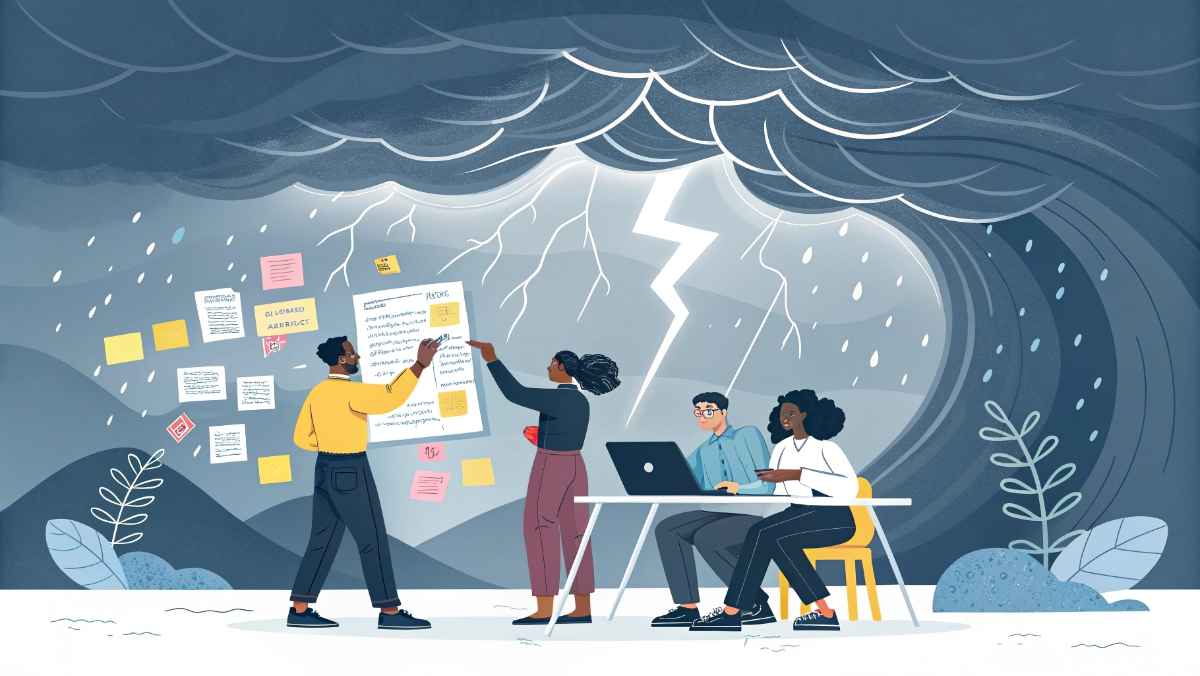
Stormuring is a powerful way to turn stress into creative energy. It reframes pressure as fuel, not fear, helping individuals and teams think faster, focus deeper, and innovate when it matters most. Instead of avoiding chaos, stormuring teaches how to ride it toward positive outcomes.
The Concept of Stormuring and Its Origins
Stormuring is a modern concept that blends the intensity of a storm with the structure of brainstorming. At its core, it is about one bold idea: stress does not always block creativity—sometimes, it unlocks it.
The idea emerged from fast-moving, high-pressure work environments where calm conditions were rare. In these spaces, deadlines were tight, expectations were high, and traditional brainstorming often failed because it relied on comfort and long reflection. Teams needed something stronger, faster, and more adaptive.
Stormuring grew as a response to this need. Instead of asking people to “relax and think,” it encouraged them to acknowledge stress, stay present, and channel urgency into action. The method draws inspiration from agile thinking, design-focused problem-solving, and well-established psychological research showing that moderate stress can sharpen attention and speed up decision-making.
Importantly, stormuring does not glorify burnout or constant overload. Experts widely agree that chronic stress harms health and performance. Stormuring works only when stress is short-term, meaningful, and well-supported. This distinction is central to its ethical and practical use.
In simple terms, stormuring reframes chaos as a temporary workspace where new ideas are forced to surface. When done correctly, it replaces panic with purpose.
How Stress Acts as a Catalyst for Innovation
Stress has a bad reputation—and for good reason. Long-term, unmanaged stress is linked to anxiety, exhaustion, and reduced cognitive function. However, scientific consensus also recognizes a different form of stress: acute, manageable pressure, which can increase alertness and motivation.
Stormuring is built on this understanding.
When people face a clear challenge with a real deadline, the brain often switches into a high-focus mode. Distractions fade. Priorities become clearer. привычные (routine) thinking patterns loosen, making room for faster and sometimes more original ideas.
There are three main ways stress supports innovation in stormuring:
First, it breaks complacency: Under pressure, repeating old solutions feels risky. Teams are more willing to question assumptions and try bold approaches.
Second, it sharpens focus: Short-term stress increases attention to what matters now. This helps groups cut through noise and work on the core problem instead of side issues.
Third, it forces collaboration: When time is limited, people rely more on each other. Open communication becomes a necessity, not a choice.
Stormuring transforms stress from an enemy into a temporary tool. The key is balance. Leaders and facilitators must ensure psychological safety, clear goals, and recovery time after intense sessions. Without these supports, stress stops being productive.
When used responsibly, stormuring turns pressure into momentum—and momentum into breakthroughs.
Successful Implementation in Global Organizations
Many high-performing organizations operate in environments where change is constant and pressure is unavoidable. In these settings, stormuring-like practices have proven valuable for sustaining innovation and resilience.
Teams facing market shifts, tight launches, or unexpected challenges often report that their most creative solutions appear during demanding moments. By embracing structured intensity instead of fighting it, organizations can stay adaptive.
Successful implementation usually follows a few shared principles:
Clear purpose: Stormuring sessions are focused on specific problems, not vague discussions. Everyone knows what success looks like.
Psychological safety: Participants are encouraged to speak freely, challenge ideas, and fail fast without fear of blame. Research consistently shows that safety is essential for team creativity.
Time boundaries: Stormuring works best in short, intense bursts—not endless pressure. Defined start and end points protect energy and morale.
Reflection and recovery: After the storm, teams slow down. They review insights, document ideas, and allow space to recover. This step is critical for long-term performance.
When organizations respect these boundaries, stormuring becomes a sustainable advantage rather than a risk. It helps teams stay sharp without sacrificing well-being.
Stormwater Management: A Parallel in Environmental Engineering
An interesting parallel to stormuring exists in environmental engineering, particularly in stormwater management. While the contexts are different, the underlying logic is surprisingly similar.
In cities, heavy rainfall can overwhelm systems, cause flooding, and damage infrastructure. Instead of trying to stop storms, engineers design systems that manage and redirect intense flow in safe, productive ways.
Tools like green infrastructure, low-impact development practices, and retention systems absorb peak pressure and release it gradually. These systems are not built for constant storms—they are designed for moments of intensity.
Stormuring follows the same philosophy at a human level.
Stress, like heavy rain, is inevitable. Trying to eliminate it completely is unrealistic. The smarter approach is to prepare systems—teams, habits, cultures—that can absorb pressure without breaking.
Just as well-designed drainage protects communities, well-designed stormuring practices protect people while still allowing them to perform at their best. Both emphasize resilience, flexibility, and intelligent design over resistance.
This parallel highlights an important truth: strength is not about avoiding stress, but about managing it wisely.
Tips for Incorporating Stormuring Into Daily Routines
Stormuring is not limited to large organizations or major projects. With the right mindset, individuals can apply its principles to everyday challenges.
Here are practical, expert-backed ways to start:
Identify your pressure points: Notice when stress spikes. Is it deadlines, decisions, or uncertainty? Awareness is the first step.
Use short focus windows: Set aside a fixed time—such as one focused hour—to tackle your hardest task. Treat it as a controlled storm, then stop.
Practice simple mindfulness: Brief breathing or grounding exercises before intense work help regulate stress responses. Even a few minutes can improve clarity.
Visualize ideas: Mind maps, quick sketches, or written lists help externalize thoughts when the brain is moving fast.
Reflect after intensity:
Once the pressure passes, review what worked and what didn’t. This turns experience into learning.
Experts agree that recovery matters as much as effort. Stormuring should feel energizing, not draining. If stress lingers long after the task ends, adjustments are needed.
Used correctly, stormuring can restore momentum when creativity feels stuck.
Creating a Culture of Resilience and Teamwork
Stormuring thrives in cultures that value trust, openness, and shared responsibility. Without these foundations, pressure quickly turns toxic.
To build a healthy stormuring culture, leaders and teams should focus on a few essentials:
Open communication.
People must feel safe sharing ideas, doubts, and failures. Silence under pressure is a warning sign.
Respect for limits: High performance does not mean constant intensity. Rest, flexibility, and empathy are not weaknesses—they are performance tools.
Shared ownership: Stormuring works best when success and failure belong to the team, not individuals alone.
Visible leadership: When leaders model honesty about stress and show how they manage it, others follow.
Research in organizational psychology consistently shows that resilient teams are not those with the least stress, but those with the strongest support systems.
A healthy stormuring culture turns challenges into collective growth experiences rather than personal burdens.
FAQs About Stormuring
What is stormuring in simple words?
Stormuring is a way of using short-term stress to boost focus, creativity, and problem-solving instead of letting pressure cause panic.
Is stormuring scientifically supported?
Yes. Research shows that moderate, short-term stress can improve attention and performance when paired with psychological safety and recovery.
Is stormuring the same as brainstorming?
No. Brainstorming often happens in calm settings. Stormuring is designed for high-pressure moments where urgency drives ideas.
Can stormuring cause burnout?
If misused, yes. Experts agree stormuring must be time-limited, supported, and balanced with rest to stay healthy.
Who should use stormuring?
Teams, leaders, creatives, and individuals facing complex problems or tight deadlines can benefit from stormuring principles.
Can stormuring be used outside work?
Absolutely. It can help with studying, personal projects, or decision-making during stressful life moments.
Conclusion
Stormuring offers a refreshing, science-aligned way to rethink stress. Instead of treating pressure as a threat, it shows how focused intensity—used wisely—can unlock clarity, courage, and creativity.
When supported by trust, clear goals, and recovery, stormuring becomes more than a method. It becomes a mindset: one that turns storms into stepping stones and challenges into opportunities.
In a world that rarely slows down, learning how to move forward through pressure—rather than away from it—may be one of the most valuable skills of all.








Leave a Reply